
When people think about starting or investing in a business, their minds usually jump to restaurants, retail shops, or tech startups. But some of the steadiest profits hide in plain sight, inside industries that rarely get glamorous attention but that every community depends on every single day. These niche industrial and specialty service businesses often face less competition, serve loyal customer bases, and solve problems that never really go away. If you are researching where real, durable opportunity lies, it pays to look past the obvious and into the workshops, yards, and job sites that keep everything else running.
Moving Heavy Equipment Instead of Household Boxes

Most people picture moving companies as the crews that pack up living rooms and drive rental trucks across town. That image only covers a fraction of the moving industry, because a separate and far less crowded market exists for relocating industrial equipment, factory lines, and oversized machinery. A machinery moving company handles specialized rigging, permits, and transport logistics that ordinary movers are not equipped to manage.
This kind of work commands higher rates because the stakes are higher, the equipment is expensive, and the margin for error is small. Factories, warehouses, and construction sites need this service regularly as they upgrade, relocate, or expand operations. Anyone comparing business models should note how much less price competition exists once a service requires specialized rigging skill and insurance coverage most competitors cannot match.
Storing and Shipping Goods on Wooden Platforms
Pallets seem like a mundane detail of shipping, yet they are the backbone of nearly every supply chain in existence. An estimated two billion pallets are in circulation across the country at any given time, quietly holding together everything from grocery distribution to manufacturing logistics.
A local pallet company supplies, repairs, and recycles the wooden platforms that move goods from factories to store shelves, and demand for this service never really slows down. Standard 48×40 pallets can be built new, but many businesses prefer buying reconditioned ones at a fraction of the cost, which keeps repair crews busy sorting, re-nailing, and replacing broken boards.
The recycling side adds another income stream, since damaged pallets that can’t be repaired are often broken down for scrap wood, mulch, or biomass fuel rather than sent to a landfill. This turns what looks like waste into a second and third sale from the same piece of lumber.
Because e-commerce warehouses, food distributors, and construction suppliers all rely on pallets daily, a single company can serve dozens of industries without ever needing to specialize narrowly. It’s an unglamorous business, but one where steady, repeat orders make for remarkably predictable revenue.
What makes this niche appealing is the recurring nature of the business. Warehouses and distributors need constant replenishment, and damaged pallets must be repaired or replaced on a regular cycle rather than as a one-time purchase. This creates a steady, almost subscription-like revenue pattern that many flashier businesses can only dream about.
The economics are simple but forgiving. A standard 48×40 wooden pallet often costs just $5 to $15 to produce or repair, yet a company moving thousands of units a month can turn that into consistent five- or six-figure monthly revenue. Add-on services like pallet pickup, sorting by grade, and heat-treatment for export compliance (ISPM-15 certification) let operators charge premiums well above raw material cost.
Retention is another underrated advantage. Once a business becomes the go-to pallet supplier or recycler for a regional distribution center, switching costs discourage clients from shopping around, especially when reliable delivery schedules are tied to their own fulfillment deadlines. That stickiness translates into long-term contracts rather than one-off sales.
There’s also room to diversify within the niche itself. Some operators specialize in new pallet manufacturing, others focus purely on repair and refurbishment, and a growing number build businesses around scrap wood recycling and disposal. Each angle taps the same core demand but with different equipment needs and margins, giving new entrants multiple ways to find a profitable foothold.
Cutting Precision Parts for Other Businesses
Manufacturing relies on components that are cut, shaped, and finished to exact specifications, and this is where precision machining services step in. A CNC machining company produces custom metal or plastic parts for industries ranging from aerospace to medical devices, often working from digital designs submitted by engineers.
The appeal here lies in the diversity of clients and the high value of each job. A single client might need a small batch of prototype parts one month, and a large production run the next, and pricing reflects the complexity and precision involved rather than simple hourly labor. This makes it a business model where expertise translates directly into strong margins.
Restoring Blades for Kitchens and Trade Shops
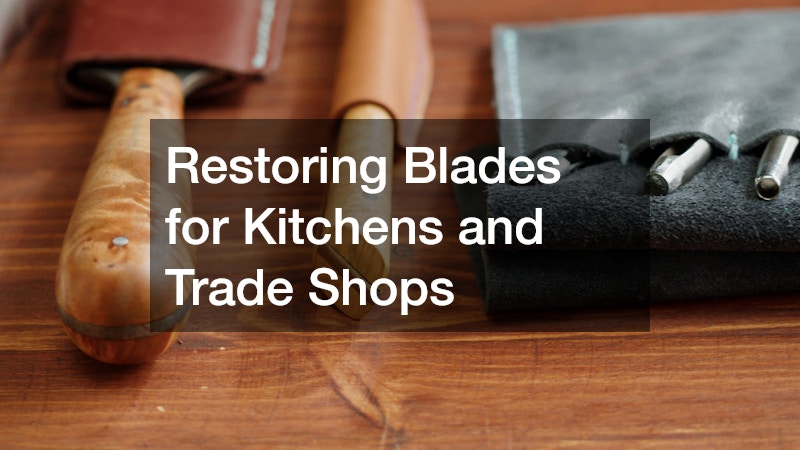
Every restaurant, butcher shop, and culinary school depends on sharp blades to operate safely and efficiently, yet almost none of them have the tools, training, or spare time to sharpen their own equipment properly. A dull blade isn’t just inefficient—it’s dangerous, requiring more force and increasing the risk of slips that lead to workplace injuries. This is precisely the gap that professional knife sharpening companies are built to fill.
Most operators structure their business around recurring routes, visiting the same twenty or thirty accounts on a biweekly or monthly cycle, swapping out dull blades for freshly honed ones in a matter of minutes. Others run drop-off or mail-in services, charging anywhere from $1 to $3 per inch of blade length depending on the knife type and edge condition. Either model creates predictable, repeat revenue without requiring a storefront.
The client base extends well beyond restaurants, too. Butcher shops need heavy-duty cleavers and boning knives serviced weekly given their volume of use, culinary schools need entire sets sharpened between semesters, and even hair salons and tattoo shops occasionally require specialty blade maintenance. A single technician with a mobile sharpening rig can often service 15 to 20 accounts a day, turning what looks like a modest side hustle into a full-time operation with minimal overhead.
- Restaurants often need service on a weekly or biweekly schedule, since dull blades slow down prep work and create safety hazards for kitchen staff.
- Startup costs are relatively low compared to other equipment-based trades — a decent belt sharpener, a few stones, and basic tools can get a mobile operator running for under $2,000.
- Mobile sharpening routes allow one operator to serve dozens of businesses in a single day, often charging $1-3 per blade or a flat monthly fee per account.
- Building a route in a mid-sized city typically means targeting delis, hotels, and catering companies alongside independent restaurants to keep the schedule full.
- Specialty clients like butchers and hunters expand the customer base beyond restaurants, and seasonal demand from hunters can provide a reliable bump in fall and winter.
- Trade shops such as salons (scissors), woodworkers (chisels and planer blades), and landscapers (mower blades and shears) add further diversification and reduce reliance on any single industry.
Determining the True Value of an Airplane
Buying, selling, insuring, or financing an aircraft requires an accurate and defensible valuation, which is where aircraft appraisal companies come in. These specialists assess condition, maintenance history, market comparables, and modifications to arrive at a fair market value that banks, insurers, and buyers can trust.
This is a highly specialized field that requires aviation knowledge most general appraisers simply do not have. Because the stakes involve six or seven figure transactions, clients are willing to pay well for a thorough and credible report. It is a clear example of how deep expertise in a small market can outperform broader, more crowded professions.
Carving Lasting Memorials for Families and Communities
Cemeteries and memorial gardens rely on skilled craftsmanship that never goes out of demand, and monument companies provide exactly that. These businesses design, engrave, and install headstones and memorial markers, working closely with grieving families during an emotionally sensitive time.
The nature of this work means demand is essentially recession-proof, since the need for memorials does not disappear during economic downturns. Success in this space depends heavily on craftsmanship, compassion, and reputation within the local community. Families often choose a provider based on referrals and trust built over generations rather than price alone.
Directing Vehicles Safely Around Construction and Events

Road work, utility repairs, and large public events all require careful management of vehicle and pedestrian flow, and this is the core function of a traffic control company. These businesses supply trained flaggers, signage, cones, barrels, and detour planning to keep both workers and the public safe.
The work itself is far more technical than simply standing in a road holding a sign. Crews must understand state and local traffic control manuals, calculate proper sign spacing based on posted speed limits, and design temporary traffic patterns that comply with regulatory standards. A single mistake in cone placement or sign timing can create serious liability for a contractor or municipality.
Contracts in this space tend to be steady and recurring rather than one-off jobs. A single highway resurfacing project might require weeks of coverage across multiple shifts, while a city’s annual marathon or festival calendar can generate repeat business year after year. Municipalities and utility companies also often prefer working with an established traffic control company because it reduces the administrative burden of training and certifying flaggers in-house.
Margins can be attractive too, since equipment like cones, barricades, and message boards gets reused across dozens of jobs once purchased. The main ongoing costs are labor, certification renewals, and liability insurance, making this a scalable niche for operators willing to invest in proper training programs.
Traffic control services occupy a specific niche: flaggers, cone trucks, message boards, and certified traffic control plans that keep workers and drivers safe around construction zones, utility work, and large public events. Municipal contracts and construction partnerships make this a reliable source of ongoing work, since roadwork, utility upgrades, and infrastructure projects are constant in growing areas. A single mid-sized city can generate dozens of active work zones at any given time, each requiring certified personnel and equipment.
Safety regulations also mean that cutting corners is not an option, which keeps qualified providers in steady demand. Certifications like ATSSA or state-specific flagger training aren’t optional paperwork—they’re legal requirements that create a real barrier to entry, filtering out casual competitors who might otherwise undercut pricing. Liability concerns push general contractors to hire specialists rather than handle traffic control themselves, since a single accident in a poorly managed work zone can result in lawsuits far exceeding the cost of outsourcing the job.
Businesses in this space often find themselves booked out for the entire construction season, particularly in regions with short weather windows where road crews compress a year’s worth of projects into six or seven months. Add in parades, marathons, festivals, and stadium events that need temporary traffic management, and the revenue streams diversify beyond construction alone. Equipment costs are relatively modest compared to other industrial niches—arrow boards, cones, and radios rather than heavy machinery—making margins attractive once the initial certifications and contracts are secured.
Stripping Surfaces Clean Before Repair or Refinishing
Before metal, concrete, or wood can be repainted, coated, or restored, old finishes and corrosion often need to be removed completely, and that is the job of a sandblasting company. This abrasive cleaning process is used on everything from industrial tanks to antique furniture, and outdoor structures like fences and playground equipment.
- Automotive restoration shops frequently outsource this step before repainting vehicles.
- Marine and industrial clients need rust and old coatings removed before recoating metal surfaces.
- Historical restoration projects rely on careful blasting techniques that avoid damaging original materials.
- Environmental regulations around containment and dust control shape how this work must be performed.
Keeping Watercraft Looking Showroom Ready

Boat owners take pride in their vessels, but few have the time, tools, or patience to maintain that showroom shine themselves. Boat detailing companies offer washing, waxing, polishing, and interior cleaning services tailored to marine environments, which differ significantly from standard auto detailing.
Seasonal demand spikes before boating season and before major sales, giving this niche a predictable rhythm that owners can plan around. Marina partnerships and referral networks often provide a steady stream of clients without heavy advertising spend. For those drawn to hands-on work with a loyal, repeat clientele, this niche offers an accessible entry point into the broader marine services industry.
The businesses that quietly keep factories, kitchens, airports, cemeteries, roads, and marinas running are often the ones with the least competition and the most consistent demand. Rather than chasing an oversaturated market, it can be far more profitable to look at the specialized, less visible services that communities cannot function without. If you are evaluating where to invest your time, money, or career, take a closer look at these overlooked industries before settling on something more obvious.